Criminal
Scum
Early Access. Windows PC. Lerk Interactive.
This manual is for players. It covers the controls, the screen, the town and every way to make money in it that the game teaches. It stops short of spoiling the story: each job is described as far as its first steps.
1. Welcome
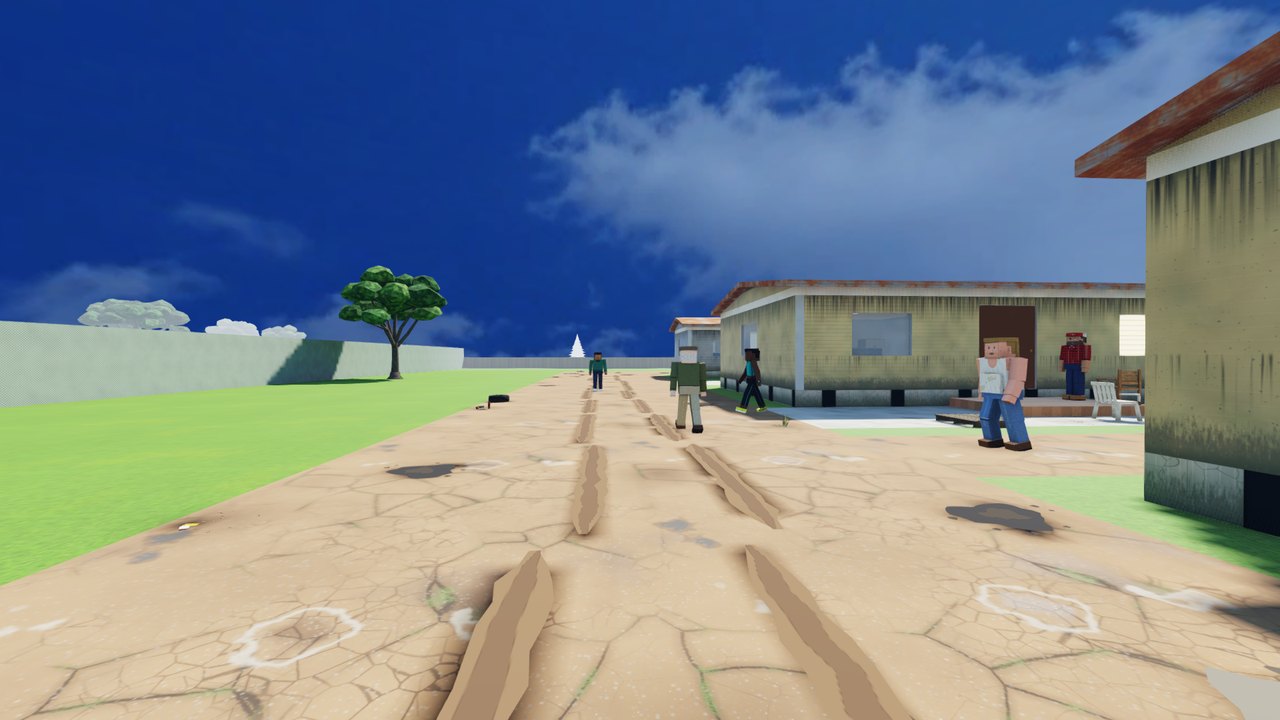
You get off the train at Mill Crossing with one bag and no money, come to look after your grandmother in her trailer at Sunny Acres. Before supper the Gallas, the gang in purple who hold her debt, shoot her in her own yard and tell you the debt is yours now. Then the phone booth at the park rings. The man on the line never gives a name. He knows where the money is, and he wants the Gallas finished as badly as you do. From Grandma's trailer you work your way up: pockets, bikes, a stolen car, a hold-up, a racket, until you are worth a real job - a house, a crew, a van - and then a better address across the tracks. Trailer Park City is small, nosy and full of people who call the police. Welcome home.
2. Controls
Every key below is a default. Change any of them under Settings > Controls (keyboard) or Settings > Controller (pad). The prompts on screen always show the key or button you actually have bound, and switch to pad glyphs as soon as you touch the controller.
Keyboard and mouse
| Action | Key |
|---|---|
| Look | Mouse |
| Fire / punch / throw what you carry | Left mouse button |
| Scope (rifle only, hold) | Right mouse button |
| Next / previous weapon | Mouse wheel (past the last: hands empty) |
| Move | W A S D (Z and Q also work with the default layout) |
| Jump | Space |
| Run | Shift (hold). With the rifle scoped: hold your breath |
| Sneak (hold) | X |
| Use (hold for the longer ones) | E |
| The loud way (kick, smash, break) | R |
| Mask on / off | M |
| Drop what you carry | G |
| Throw it | T |
| Flashlight | F |
| Quest log | J |
| Reload | C |
| Melee weapon (slot 1) | 1 |
| Sidearm (slot 2) | 2 |
| Alternate weapon (slot 3) | 3 |
| Put the weapon away (bare fists) | H (also 0 and `) |
| Inventory | Tab (also I) |
| First-aid kit | V |
| Melee: punch, or pistol-whip with a gun out | B |
| Pause | Esc |
| FPS counter on / off | F3 |
Menus: arrows or W/S to move, Enter to press, Esc to go back, Tab to cycle the focus, Page Up / Page Down to switch tabs. In the inventory and the shop: Up/Down pick a row, Left/Right change tabs, Enter / R / X do the row's actions, Esc or Tab closes.
A talk card with numbered replies (the shake-down, for one) takes 1, 2 or 3.
Cutscenes: hold Space, Esc or Enter for a second to skip. A tap does nothing.
There is no screenshot key in the game: use Steam's (F12 by default).
Controller (Xbox layout)
An XInput pad plays the whole game. Every button except Menu can be rebound under Settings > Controller.
| Action | Button |
|---|---|
| Move | Left stick |
| Look | Right stick |
| Run | Click the left stick (L3), or push it fully (a setting) |
| Fire / throw what you carry | RT |
| The loud way (hold) / the rifle's scope | LT |
| Use (hold for the longer ones) | X |
| Jump | A |
| Sneak | B (press to toggle, or hold: a setting) |
| First-aid kit | Hold B |
| Next weapon | Y |
| Put the weapon away | Hold Y |
| Reload | RB |
| Throw it | LB |
| Flashlight | D-pad up |
| Inventory | D-pad down |
| Mask on / off | D-pad left |
| Drop what you carry | D-pad right |
| Quest log | View |
| Melee: punch / pistol-whip | R3 (click the right stick) |
| Pause | Menu (fixed) |
Menus: D-pad or left stick to move, A to press, B to go back, LB / RB to switch tabs. A talk card's replies: LB, RB and X. Cutscenes: hold B for a second to skip. Arcade cabinets: hold B for a second (or press View) to walk away.
Minigames (the dial, the lock, the keypad, the hotwire, the ATM) take the right stick, A, B and LT.
Driving
| Action | Keyboard | Pad |
|---|---|---|
| Throttle / brake (held when stopped: reverse) | W / S | RT / LT |
| Steer | A / D | Left stick |
| Handbrake | Space | A |
| Camera (chase / seat) | C | RB |
| Look around | Mouse | Right stick |
| Get out | E | X |
3. The HUD
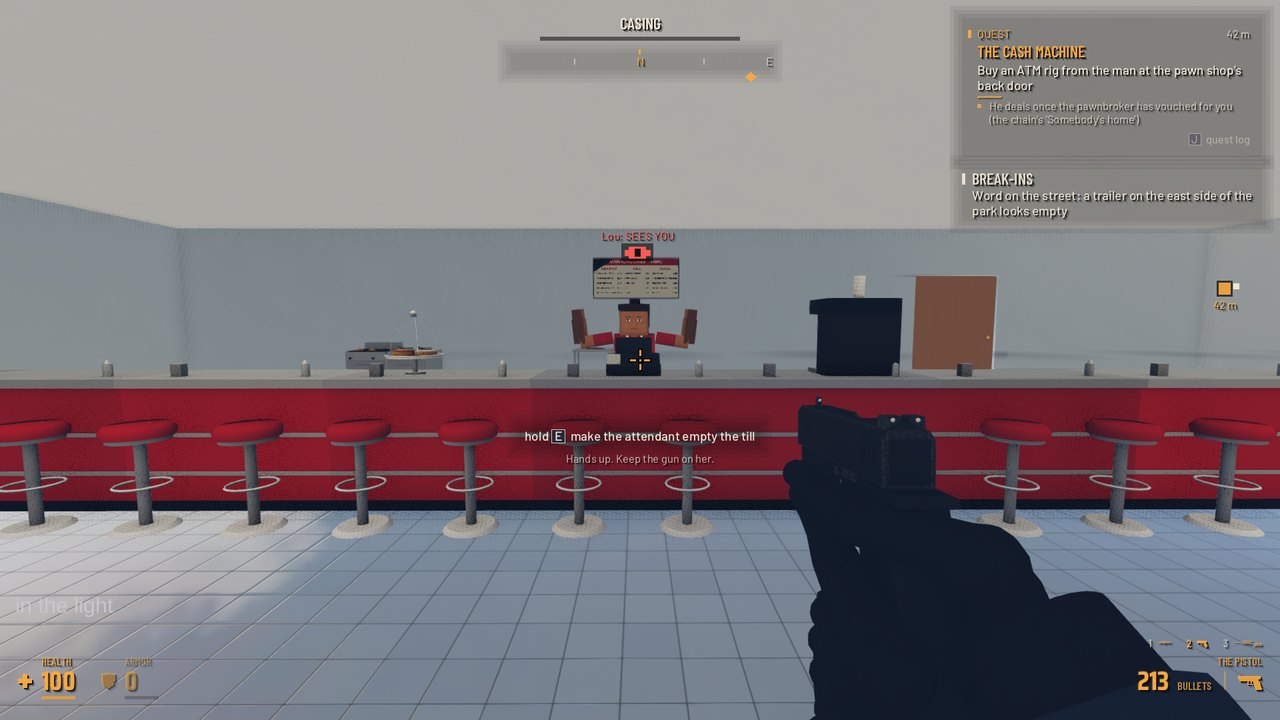
Everything sits straight on the picture. Amber is the game's one colour; red means danger.
- Bottom left - vitals. HEALTH and ARMOR as big numbers with a thin bar under each. Health turns red when it drops; a number flashes when it changes.
- Bottom right - the weapon. Rounds loaded in big type, the reserve (or the ammunition's kind) small beside it, and the weapon's silhouette. Low ammunition blinks red. With nothing in hand it says UNARMED, quietly. In a car this corner shows your speed, the car's condition (red under a third) and, on a stolen car, STOLEN - or HOT, blinking red, once somebody has reported it. Pickups ("+12 BULLETS") stack over it and fade.
- Top right - the column. From the top:
- WANTED and your stars, with the pursuit's state under them: RESPONDING (a car is on its way), SEEN, or SEARCHING with a countdown. The stars blink while they search for you.
- The quest panel: QUEST or ON OFFER, the distance to the marker, the quest's title, the current objective, a progress count and bar where a step counts things, and the step's hints. It slides in and glows amber when the objective changes.
- Toasts: a new quest, a step done, a quest complete, what you just lifted ("Lifted: $25 ..."), what the police kept. Four at most, newest at the bottom.
- The last note: a line the game wants you to remember.
- The marker. A diamond with the distance on your objective when it is on screen; an arrow at the edge of the screen pointing the way when it is not. During a call it sits on the ringing booth.
- The compass. A strip of N E S W with a tick every 45 degrees and your target's mark on it.
- Top left - the radio feed. The police band: "Dispatch: a 911 call ...". New calls slide in under the old ones and fade after a few seconds. If you hear them talk about you, they are coming. The FPS counter (F3) and the co-op status sit above it.
- Under the crosshair - prompts. What you are looking at and what you can do with it: "E take the watch", "hold E pick the lock (3 picks)", with the loud alternative on R. A hold fills a ring; let go, look away or walk off to cancel.
- The eye. Over a local in reach: an open red eye means SEES YOU, a half-open yellow one means they could turn any moment, a shut green line means UNAWARE. While you pick a pocket a NOTICED bar fills next to it. If it fills before your hand is out, they catch you.
- Hits. Red triangles at the screen's edge point toward whoever just shot you. An X on the crosshair means your shot landed; a double tick means a headshot.
- Subtitles sit bottom centre with the speaker's name over the line. The caller is subtitles only.
- BUSTED / WASTED fills the middle of the screen when the police cuff you or put you down. After an arrest a RELEASED card lists what they kept (section 6).
4. Getting around
Walking, sneaking, running. Hold X to sneak: you crouch, move at a third of your speed and your footsteps go nearly silent. Sneaking also makes you harder to see from a distance, and fits you under tables and through windows. Let go under something low and you stay down until there is room to stand. Hold Shift to run: faster, louder, and easy to notice. Running past somebody while you are picking their pocket gets you caught at once.
Carrying things. A bike, a TV, a big package or a loot bag goes in both hands. You cannot jump or draw a gun with one, and the heavier it is the slower you go. G drops it, T (or the left button) throws it - at a crewmate, out of a window, into the van.
Doors and windows. E opens a door you have a right to. A locked one offers its lock: hold E to pick it (quiet, slow; a pick can snap and you lose it) or R to kick it in (loud, and the whole park hears). A window is pried (quiet) or smashed (loud), then hold E to climb through. From inside, every lock opens by hand. Some doors only give you the loud way from outside; some houses have an alarm on the circuit and a panel whose wires you can cut.
The phone booth. There are three: at the park's entrance, by the gas station and outside the motel. When the caller wants you, the nearest booth you cannot see rings - a bell you can hear across the block, a flickering lamp, and the quest marker on it. E answers and his lines come up as subtitles; E again hangs up early and the rest of what he said goes to your quest log. A call you miss rings again a little later at another booth. The phone never rings while the police are after you.
The quest log (J). Two columns: on the left the quests - the current one, the jobs on offer, the ones done; on the right the chosen quest's steps, the done ones ticked, the current one's hints, and the last call word for word. Side jobs are listed as SIDE JOB.
The inventory (Tab). Tabs for WEAPONS (one weapon per slot carried, the rest left at home), GEAR (use a first-aid kit or put on a vest), AMMO, LOOT (the stolen goods you carry and what they are worth) and, once you run the bags, LEDGER. Swapping weapons from home works anywhere - except with the police after you. Alone, the world stops while the inventory is open; in co-op it does not.
Grandma's trailer. Lot one, Sunny Acres. It is yours now, and four things in it matter:
- The bed. E to sleep. The night passes, your rackets' cuts come in, and the game saves. You cannot sleep with the police after you.
- The stash, in the bedroom. E opens it: cash, stolen goods, gear and ammunition in and out. R puts every dollar on you straight in. The police never search the stash (section 6).
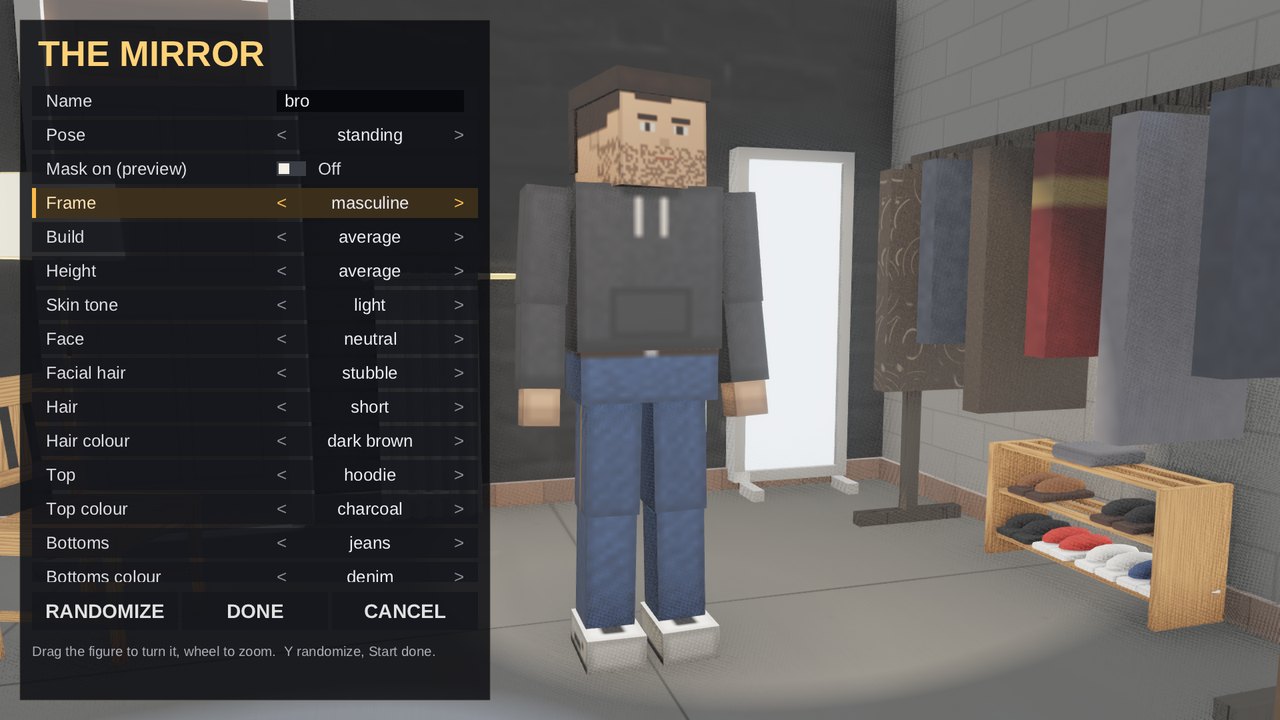
- The mirror. Your character again - the look and the nickname. CANCEL keeps the old ones.
- The board, on the partition. Locked at first, with a note: "Not yet. The phone will tell you when." When the caller gives you a real job it goes up here: pick it, read the briefing, and the van takes you there.
Your character. A new game starts in a dressing room: Up/Down pick a row, Left/Right change it, drag the figure (or Q / E, or the right stick) to turn it, the wheel zooms to the face, POSE plays a clip, MASK ON shows your heist mask, RANDOMIZE rolls the lot, DONE saves. Your crew sees the result. The first time, a name is required.
5. Crime 101
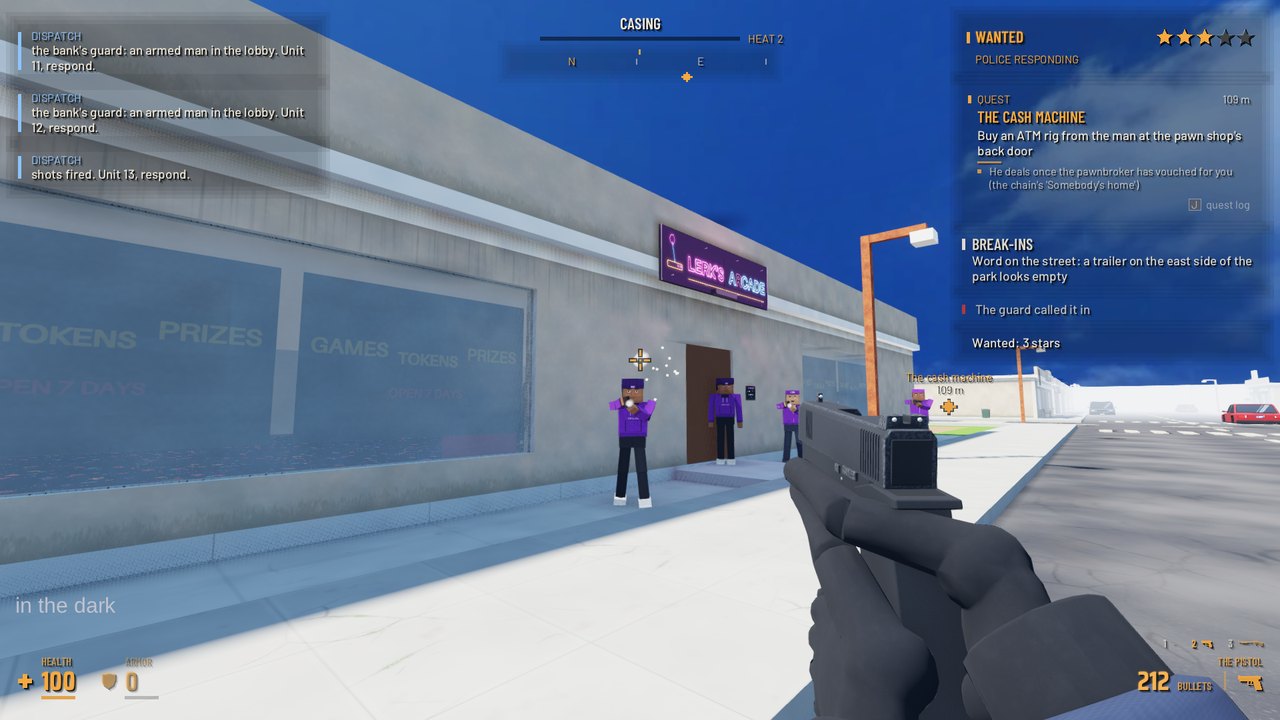
Each of these is taught by the caller in order. The hints on the quest panel repeat the essentials.
Picking pockets. Come up behind a calm local, holding X, and hold E. Watch the eye over their head: shut and green is what you want. Your hold fills against their NOTICED bar - barely from behind, fast from the side, instantly from the front. Let go if NOTICED is winning and it ebbs. A clean lift brings no police: they find out later and have nothing to tell. A fumble makes them shout, run and call it in.
Mugging. Draw a gun (2) and get within a few steps: their hands go up. Hold E and they hand over everything. Without a gun, hold R to shove them for their wallet - the timid pay, the brave fight or run. Either way it is a robbery to their face, and somebody calls the police. Punching people (left button with your fists up) works too: enough punches knocks them down, and a downed local is robbable - but the brave ones hit back.
Bikes. E on a bike lifts it into both hands. A chained one needs hold E to cut the cable lock. Walk it to the pawn shop's counter (or its front door if it will not fit) and E to sell. The owner or a passer-by who sees you lift it will call.
Fencing. The pawnbroker at Harlow Pawn & Loan buys anything you stole: E at the counter, then SELL. Goods are HOT on the day you took them and sell for less - sleep on them first. He will not deal while the police are after you.
Burglary. A trailer whose owner is out: pick the front door (hold E, uses a pick) or kick it (R, loud). Take what is lying around - counters, couches, nightstands, dressers - and search for the stash: everybody hides it in the same three places, so find the fourth. Owners come home. After a break-in the park is too hot for another for a while; the word on the street tells you when a trailer looks empty again.
Car theft. E at a front door tries it. Locked: hold E with a slim jim (sold at the pawn shop; quiet, a small chance of the alarm) or R to put your elbow through the window (loud, the alarm wails, the park hears it). Then hold E to hotwire it: strip the two thick wires, twist them, touch the thin one until she catches. A hotwired car stays running.
The chop shop. Rail Rd Auto & Salvage, by the scrapyard, with a roll-up door standing open. Drive in until the marker is over the bonnet, stop, E, and the boss makes an offer by the model and the condition - E sells, driving out keeps it. He takes any car that is not yours once he knows you, and never while you are wanted.
Hold-ups. Any counter with a clerk behind it: liquor store, laundromat, diner, the arcade's prize counter, a bank teller. Walk in with the gun out and keep it on them until their hands go up, then hold E and they empty the register. Some reach under the counter for the silent alarm instead; then you have minutes, not hours. The customers see it and the clerk calls it in once you are gone. A register takes a while to fill again.
The laundromat. Suds-N-Duds' washers, dryers and change machine are full of quarters: hold E on a coin box to pry it. No gun needed, but a box can give with a bang. Look at a machine and it tells you if anybody can see you; wait for the quiet spell when the customers go and the attendant steps into the back. Closed for cleaning is the bigger version, offered after your first hold-up: a gun on the attendant, tell her to close up, let the customers walk out, lock the front door behind them, then the machines, then the till - and out the back door into the alley, never the front. Leave the shop and the job is off.
The diner. The Starlite's register robs like any other. Or talk to Lou at the counter (E, then E again) and offer protection. She says no. Make the point - scare a customer or break something - and ask again. After that an envelope fills at the register every night you sleep; hold E on the register to collect it. It banks up for a fortnight at most.
The cash machine. The ATM on First Mill Savings' front wall. Buy the rig from the man at the pawn shop's back door, hold E at the machine and run the handshake: lock each byte while the sweep is in the green. Three bad bytes and it locks itself for a while; the bank's silent alarm wakes half a minute in. A success pops the tray: hold E on each cassette. Whoever sees the tray open calls it in. The machine fills again after a while.
The bank. First Mill Savings is the biggest score in town, and it is a plan, not a hold-up. Case it by day: look at the cameras, the guard, the vault door, the back door on the alley. Walk in unarmed and ask the manager about opening an account - the excuse to stand at the right spots and listen to a man who likes to talk. Buy the thermal drill. Hire the old box man at the diner's counter. Then knock out the power substation by the tracks the same night (wire cutters, the pallets on West Rd, or the control building's front door; the breakers lightest load first, or a charge on a transformer if you do not mind the whole county knowing). With the lights out the job goes on your board. The vault's bills are marked: wash them at the laundromat's back door or take less from the fence.
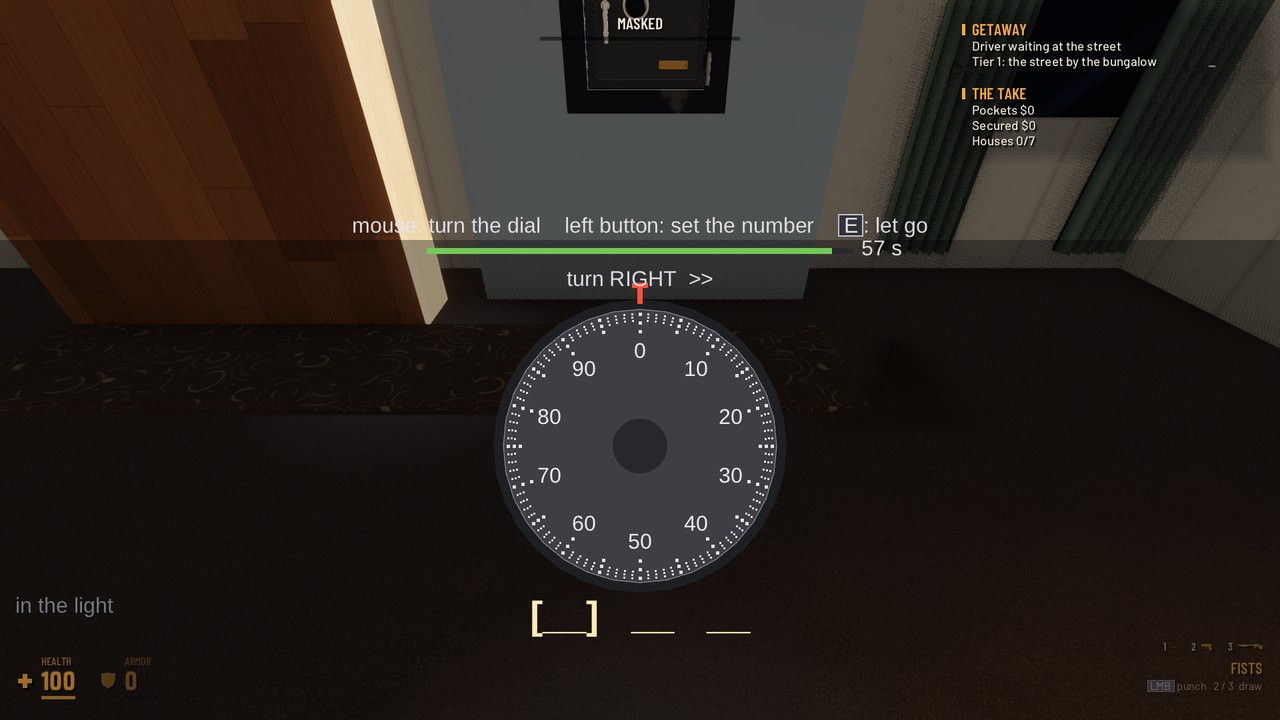
The job. When the caller rings with real work he gives you a shopping list: a duffel bag, a ski mask, work gloves and lockpicks from the pawn shop; a driver (Tito, at the gas station's pumps) and a lookout (Marisol, in the laundromat), both paid up front; and a van from the used-car lot. Then the job is on the board. The house is a level of its own at night: the hidden safe (open the covers, knock on walls, follow the clues), the dial or the keypad or the drill, the loot bag, the neighbours, the patrol car, the van as the way out. Anything that comes to rest in the van's zone is secured; what you leave behind does not count. Back home, the take is goods in your inventory until the pawn shop turns it into cash.
Rackets and the war. The woman on the alley corner pays you instead of Dutch. Jade and Marco at the motel want out from under their old owners, and offer the work only if you are carrying a gun. The caller's bags sell every night once you find two people in the park who will sell them and keep the ledger honest. Each cut comes in by the day: sleep, then collect in person. Once your rackets run, the Gallas come to collect Grandma's debt out of them, and the war is on - their corner on Mill St, their stash on Rail Rd, and Saint in the back of the arcade.
6. The police
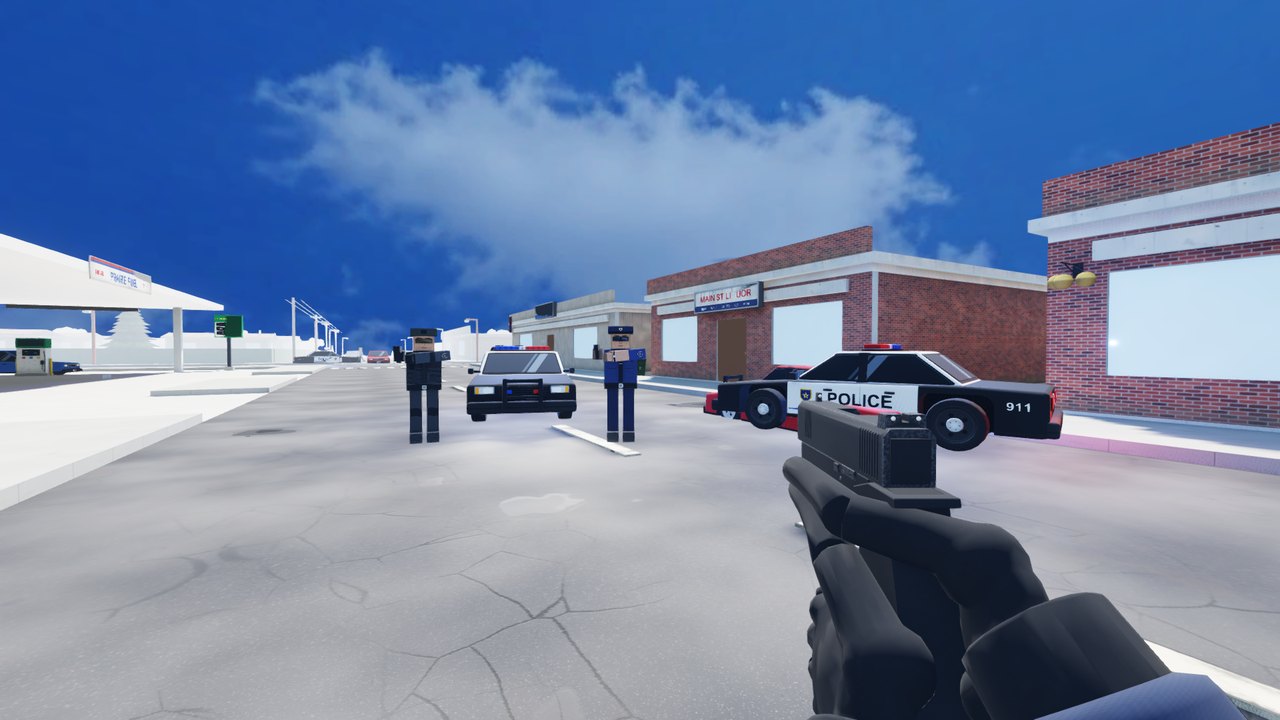
Stars. WANTED shows one to five stars. A nuisance (a fumbled pickpocket, a car alarm) is one; a robbery, a drawn gun or shots fired is two; a shooting or a killing is three; an officer shot is four. Each new act - a shot, an assault, a theft, a new victim - adds a star. Five locals calling about the same shot does not: it only tells the police where you were last seen. A drawn gun on its own sets a floor and never adds a star however many people see it.
What brings them. Somebody has to see it and call it in, or an alarm has to go: a witness on the phone a few seconds after the crime, a clerk's silent alarm, a smashed car's alarm, a guard at the bank, a doorbell camera that caught your bare face on a house job. A clean pickpocket from behind, unseen, brings nobody. The dispatch call on the radio feed tells you when the call went out.
What comes. A car per star, two officers each; at three stars backup, at four the heavy unit. Cars arrive from where you cannot see and park at the nearest approach; the officers get out, go to where you were last seen and search the block from there, each car a different way round so it is cut off. Unarmed, or with a gun you have not fired, they come to arrest you. Armed, after shots, they shoot to kill.
Losing them. Break their line of sight. Every second nobody sees you counts toward the search running out - ten seconds and a few more for every star, and the stars blink while it runs. Seen again, it starts over. Standing behind a wall while an officer works round the block does not count for much; a hide spot does - the dumpster corral in the alleys, the scrapyard's hulks, the bushes by the pond - and so does sneaking. When they give up, the stars go, the officers walk off and the cars leave. The first time it happens the caller has told you to expect it.
Shops. In the laundromat job the front door is locked from inside; if the police arrive they kick it in and the lock is gone. Nobody comes in otherwise.
Arrest - what they keep. When the cuffs go on, the search takes:
- every weapon you are carrying - all three slots, including a knife or knuckles - with the silencer on it and every round and shell on you;
- the stolen goods on you (evidence);
- the bags (the ledger counts them lost);
- the burglary tools: lockpicks, the slim jim, the drills, the vault cracker, the keypad bypass, the wire cutters, the charges, the ATM rig, the ski mask and the duffel bag;
- every dollar of cash on hand.
They never find: first-aid kits, the vest, duct tape, the gloves, the weapon light, the weapons you left at home, and anything in the stash at the trailer. The stash is never searched. Keep your savings and your spare guns there. You come to at the trailer the next morning with a RELEASED card listing what they kept. The confiscation is saved the moment it happens.
Death. WASTED costs nothing but the night: you wake at the trailer with everything you had. The heat is gone either way.
7. Weapons and gear
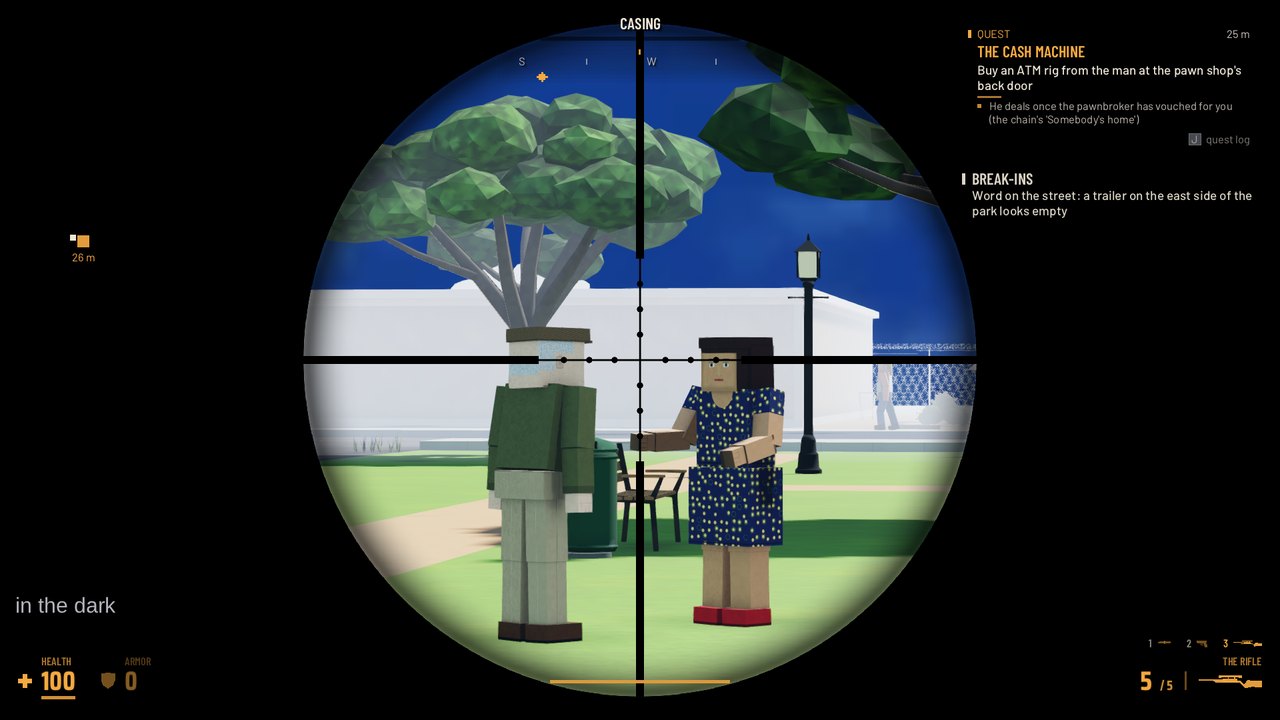
The loadout rule. You carry three slots: one melee weapon (slot 1: brass knuckles or a knife), one sidearm (slot 2: a pistol or a revolver) and one alternate (slot 3: the shotgun, the machine pistol, the rifle or the belt-fed machine gun). Everything else you own stays at home and is swapped in from the inventory, anywhere but with the police after you. 1 / 2 / 3 draw a slot, the wheel (or Y) goes round fists - melee - sidearm
- alternate - away, H puts everything away. Your fists need no slot.
Fists. Left button to punch: a cross and a hook, held for a flurry. Punches knock people down; they do not kill. B with a gun out is a pistol-whip. Hitting an officer with your fists is an assault; with a gun it is an armed one.
Brass knuckles. The same punches, harder - the locals go down in fewer. Still only a knock-down.
The knife. A slash, and a stab on a quick second press. It kills, and quietly: no gunshot for the police to hear. Close behind somebody who has not seen you - a local, an officer on his beat, a Galla at his post - hold E for a silent takedown. Note: the police treat a knife as concealed until you use it, so you can be arrested as "unarmed" with one on you - but the search at the station finds it, and it goes.
The pistol. Your first gun is the one the caller leaves in the dumpster behind the diner. Every round in the reserve is ready; there is no magazine to manage. It carries the flashlight (F) once you buy the weapon light - useful in a dark house, and the quickest way to be seen.
The shotgun. Loud, short-ranged, devastating close up. Pumps between shots; no reload needed.
The machine pistol, the rifle and the machine gun load from a magazine or a belt: C reloads (or they reload themselves when empty). The rifle has a scope: hold the right button (LT on the pad) to look through it; the reticle drifts, and holding Shift holds your breath to steady it until the breath runs out. The machine gun is heavy and slow to raise, and its near misses are heard where they land.
Silencers fit the pistol and the shotgun. A silenced shot does not turn a quiet job loud and the police do not hear it; it still hurts whoever it hits.
Where to buy.
- Harlow Pawn & Loan, the counter: a cheap pistol, brass knuckles, a knife, boxes of 9 mm and shells, the weapon light, lockpicks, a slim jim, first-aid kits, duct tape, bolt cutters, the job's duffel bag, ski mask and gloves, and a keypad bypass from under the counter. And the fence.
- The dealer, at the pawn shop's back door. He talks to you once the pawnbroker has vouched for you (after the caller's burglary) or once your name carries. The shotgun, a better pistol, the .38 revolver, the machine pistol, the scoped rifle, the belt-fed machine gun; silencers; the armour vest; the safe drill, the thermal drill, the vault cracker, the keypad bypass, bolt cutters, timed demolition charges, the ATM rig; ammunition by the carton and belt; the big first-aid kit.
Armour. Put a vest on from the inventory's GEAR tab. It takes its share of what hits you and shows as ARMOR.
First-aid kits. V uses one (hold B on the pad), or use it from the inventory. Houses on a job have kits in them.
Tools and what they are for.
| Tool | Use |
|---|---|
| Lockpicks | Doors and padlocks. One snaps now and then |
| Slim jim | A car's lock, quietly |
| Duct tape | Tape over a doorbell camera (hold E) |
| Ski mask | M. A masked face cannot be identified by a camera; a masked figure is also what the police look for |
| Gloves, duffel bag | The job's kit |
| Safe drill | The loud way into a safe |
| Keypad bypass | A digital keypad safe |
| Thermal drill, vault cracker | The bank's vault |
| Bolt cutters | Chain-link fences |
| Timed charge | A transformer, the loud way |
| ATM rig | The cash machine |
| Weapon light | The pistol's flashlight |
Guns dropped by officers and Gallas, and guns found in houses, go into your weapons too.
8. Vehicles
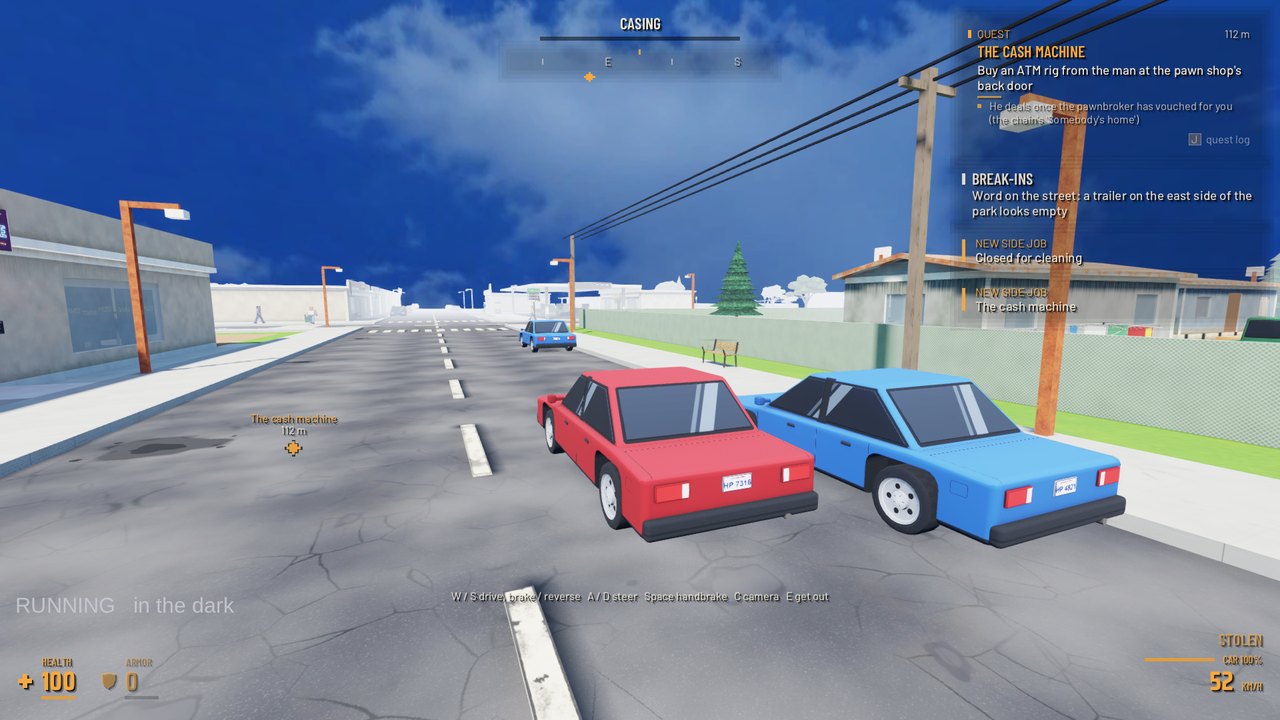
Getting in. E at a front door. Unlocked: in and away. Locked: a slim jim or the window, then the hotwire (section 5). E gets you out again - from the driver's side if there is room, not above walking pace. A hotwired car stays running; E gets back in.
Driving. W / S throttle and brake (hold S when stopped to reverse), A / D steer, Space the handbrake, C swaps the chase view and the seat. The controls are shown on screen for a while when you get in.
Damage. The car's condition is under your speed; red is a car about to quit. Every car is solid to every other: hit hard and both cars take it, you feel it, and a parked car's alarm goes off. The chop shop pays less for a wreck.
People and cars. Driving into a local hurts them by your speed; fast enough kills. Hitting a parked car hard is a hit and run if anyone saw. Both bring the police. A police cruiser you see on the road is as solid as anything else.
Stolen. STOLEN sits quietly under your speed in a car that is not yours; once it is reported it reads HOT in red, and an officer who sees the car raises the heat.
Selling. Any car that is not yours goes to Rail Rd Auto & Salvage once the boss knows you. Your own van, bought at the used-car lot for the jobs, is never for sale: it waits at the trailer.
9. The town
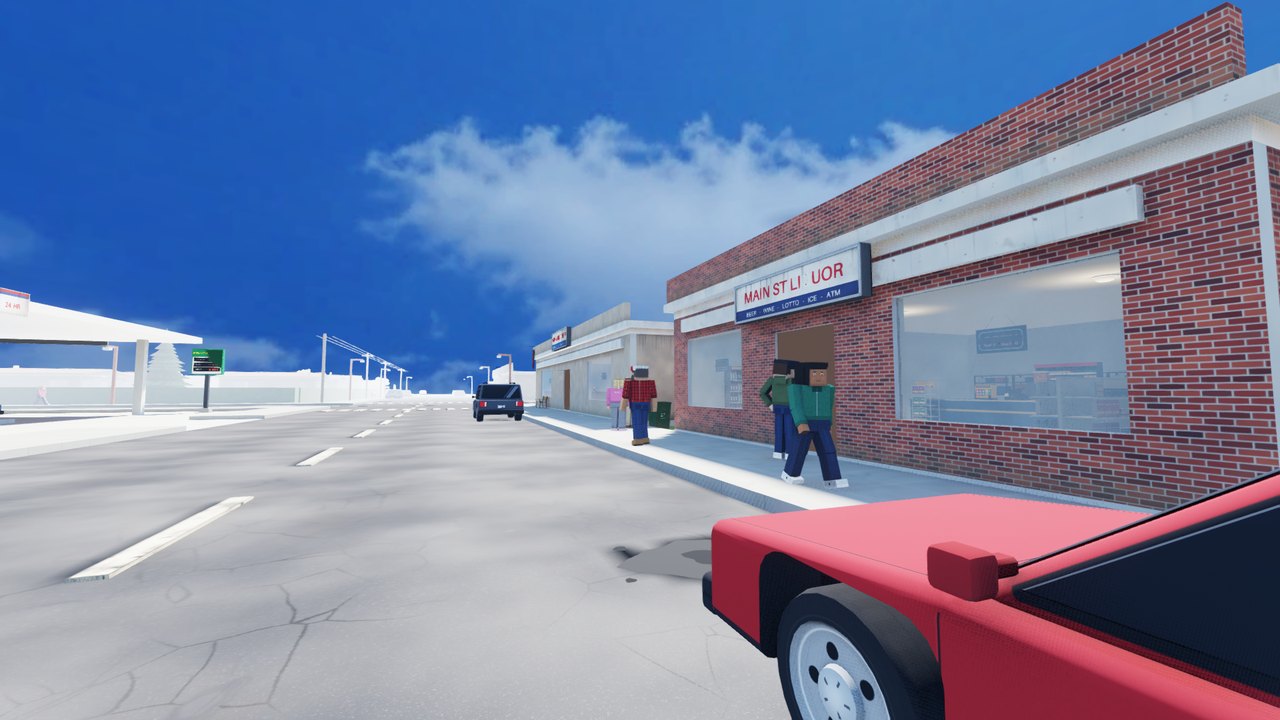
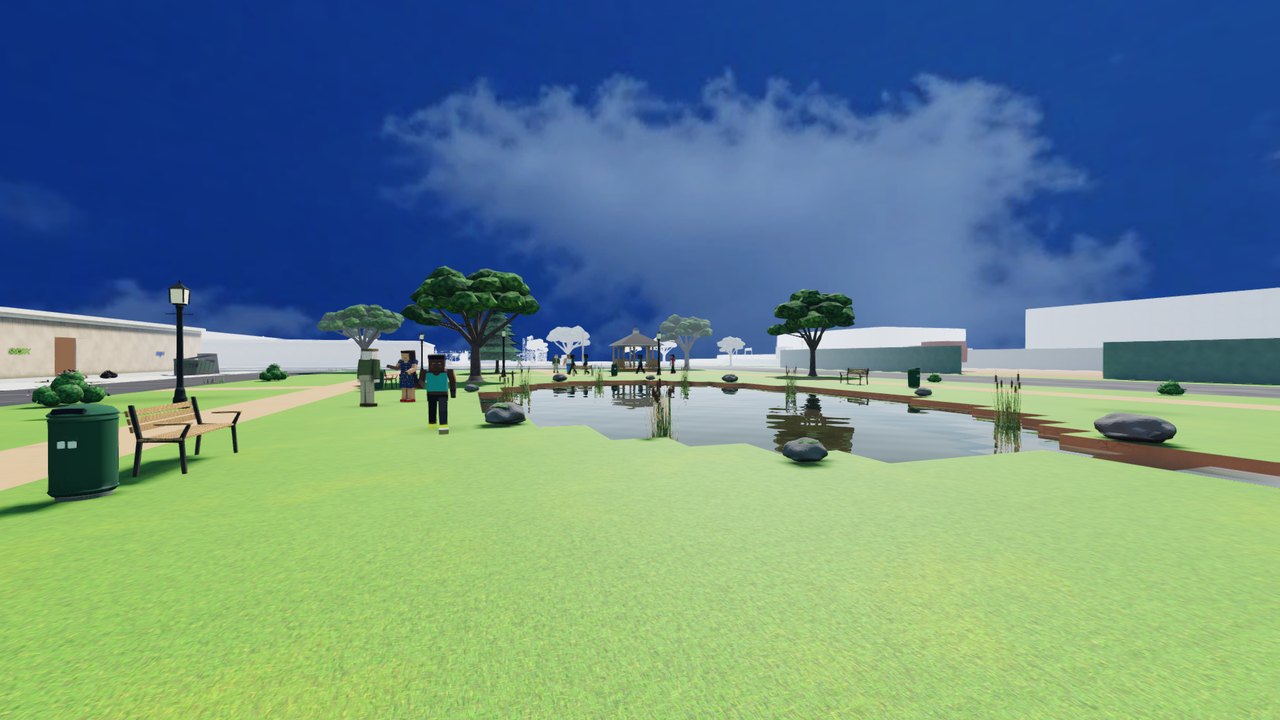
Trailer Park City is one district: a mobile-home park, a strip, the alleys behind it, a park with a pond, a rail line along the north edge and a scrapyard at the east end.
- Sunny Acres. The mobile-home park. Grandma's single-wide is lot one. Twenty-odd trailers on gravel lots, junkers on blocks, the park office, the dumpster corral, porch chairs with people in them. Every trailer has a door.
- Mill Crossing. The train stop on the embankment at the north edge. You arrive here, and one day you leave.
- Main Rd - the strip. Read the signs: STARLITE DINER (Lou's; pie's cherry today), HARLOW PAWN & LOAN (the fence out front, the dealer out back), the liquor store (BEER - WINE - LOTTO - ICE - ATM), SUDS-N-DUDS COIN LAUNDRY, PRAIRIE FUEL with its FOOD MART kiosk and Tito at the pumps, the motel - an office and a row of eight doors, Jade on its corner and Marco on its walkway, PELLAM & GRUBB REALTY east of the bus stop with the listings in its window, the used-car lot with the salesman in his office, the bus stop with Darlene at it, and a phone booth each at the park's entrance, the gas station and the motel.
- Millpond Park. The pond, the footbridge, the reeds, the gazebo, the benches, people who stand about all day and a path on the alleys' side. The bushes by the pond hide you.
- The alleys. Dumpsters, back doors, the dumpster corral, the lit corner where the woman works, the Gallas' corner on Mill St with the vacant lot behind it.
- LERK'S ARCADE, on Main Rd. Eight cabinets and a racer, open to the public; E on a cabinet plays it. Today CRANKSHAFT CLIMB is a real game you can play; the other screens say INSERT COIN (one is OUT OF ORDER). Esc, View or B held for a second walks away. Its high scores are saved with your profile. The prize counter's till and the change machine rob like the laundromat's. Through the staff door at the back is somebody else's business.
- FIRST MILL SAVINGS, on the corner of Main Rd and East Rd. Three tellers behind glass, a guard by the door (two in the lobby by day), the manager in his glass office, the vault behind the brass rail, the ATM on the front wall, the back door on the alley. Open 9 to 5.
- TRAILER PARK CITY POLICE. The station: a desk sergeant who asks you to take a number. Nothing to do there yet but look at it, and be careful where you point things.
- RAIL RD AUTO & SALVAGE. The chop shop on Rail Rd at the scrapyard end of town: the roll-up door, the bay, the boss. The scrapyard beside it is the Gallas' second corner, the caller's man's spot, and a good place to hide.
- The substation. Harlow County Power's fenced yard by the tracks: two transformers, a control building, two utility guards, and the reason the bank's cameras ever go dark.
- Cedar Glen is across the tracks. You cannot walk there. You buy your way in.
10. Settings
Settings is on the main menu and the pause menu. APPLY puts changes in force, REVERT drops them, DEFAULTS resets the tab (then APPLY), BACK asks if changes are pending. Most options take effect at once; the two that need a restart say so.
Graphics
| Option | What it does |
|---|---|
| Display mode | Windowed, fullscreen or borderless |
| Resolution | The display's modes, largest first (windowed: the window's size) |
| Vertical sync | Locks the frame rate to the monitor; stops tearing |
| Frame cap | A limit on the frame rate; with vertical sync on, the nearest divisor of the refresh rate. Uncapped is 0 |
| MSAA | Hardware anti-aliasing: Auto (4x), Off, 2x, 4x. Takes effect after a restart |
| FXAA | A cheaper post-process anti-aliasing. Fine on its own at low cost |
| Shadow quality | Low, Medium, High, Ultra |
| Bloom | The glow around bright lights |
| Ambient occlusion | Soft shadowing in corners and under things: Auto, Off, Low, High |
| Contact shadows | Small, sharp shadows where things touch: Auto, On, Off |
| Visibility culling | Skips drawing what the level knows you cannot see. Leave it on |
| Prop batching | Draws small props in batches. Leave it on |
| Small props' draw distance | How far away small props are still drawn: Near, Normal, Far, Unlimited |
| Render scale | Draws the picture smaller (50 to 100 %) and scales it up to the screen. The single biggest frame-rate gain on a slow GPU; the HUD stays sharp |
| Frame-time log | Writes every frame's timing into the engine's log file for a bug report. Starts after a restart |
| FPS counter (F3) | The frame counter top left. F3 in play flips it too |
Performance tips. If the game stutters or runs slow, in order: turn Render scale down in steps of 5 (85 % is hard to see, 70 % still looks fine), set Shadow quality to Medium, Ambient occlusion Off, MSAA Off (keep FXAA), Small props' draw distance Near. Leave culling and batching on. If the frame rate is high but uneven, turn Vertical sync on, or set a Frame cap your machine can hold at all times. If you are reporting a performance problem, turn on the Frame-time log, restart, play until it happens, and send the log (section 15).
Audio
Master volume, Music, Effects. The sliders are heard at once.
Controls
Mouse sensitivity, Invert mouse Y, and a key for every action in the keyboard table above. Click a binding and press the new key; Esc cancels. A key already in use moves to the new action and its old action is left unbound until you give it one. F3 and Esc are fixed.
Controller
| Option | What it does |
|---|---|
| Look sensitivity, across / up-down | The right stick's speed |
| Invert look up / down | |
| Response curve | Linear, Classic (a gentle middle), Precise (gentler still) |
| Inner dead zone | How far the stick moves before the look starts |
| Outer dead zone | Where full speed begins |
| Aim slowdown over people | The look slows while your gun is on an officer or a local |
| Run | Click the left stick, or push it fully |
| Sneak button | Press to toggle, or hold |
| Vibration | Rumble on shots and hits, and its strength |
| Bindings | A button for every pad action; Menu stays Pause |
Gameplay
| Option | What it does |
|---|---|
| FPS counter (F3) | The same switch as in Graphics |
| Subtitle size | Small, Medium, Large |
| HUD scale | 75 to 150 % |
| Blood and gore | Full (everything), Reduced (a red mist only: no drops, pools, wounds or spatter), Off (no blood at all). Takes effect at once |
11. Co-op
Co-op is for the jobs: the contracts on the board. Up to four players. The town itself - the quests, the caller, the rackets - is one player's today.
From the main menu, CO-OP:
- HOST A GAME (STEAM): a friends-only lobby through Steam's relay. No port forwarding. Your friends join from JOIN A FRIEND, from a Steam invite, or from "Join game" on your Steam profile. In the pause menu, INVITE FRIENDS opens Steam's invite overlay.
- HOST A GAME (LAN): your machine listens on port 27030; your address is on your screen's co-op line.
- JOIN A FRIEND (STEAM): a list of your friends' open games.
- JOIN BY ADDRESS: the host's IP, or IP:port.
Without Steam running, the LAN options still work.
How a job works with a crew. The host picks the contract and everybody reads the briefing. Each player's own machine runs their own movement and their own minigames; the host decides everything shared - the alarm, the police, the loot, who holds the safe. Only one player can work a lock or a safe at a time; the others see a progress bar over it. Anything in the van's zone is secured for the whole crew. A thrown bag can be caught by a crewmate in its path. If a player goes down, the job is custody for them; a client who leaves simply leaves the crew.
Profiles. Every player earns into their own profile on their own machine, and their own Steam Cloud. A guest who has not finished the town's chain can still join a host's job.
12. Saving and Steam Cloud
When the game saves. By itself: when you sleep, after a job's payout, after a purchase or a sale, when a quest step is done, when an arrest takes your things, and when you pick SAVE AND QUIT TO MAIN MENU or QUIT GAME from the pause menu in free roam. The main menu's CONTINUE line shows when the save was made.
Where. The game's own folder (Steam > Manage > Browse local files), under user/: your profile, your settings, and the arcade's scores. Uninstalling the game removes them locally; the cloud copy survives and a reinstall brings it back. A copy of the profile from before you last chose NEW GAME is kept beside it as a safety net.
Steam Cloud. Your progress, your settings (key bindings, pad settings, blood, subtitles, HUD scale) and the arcade high scores follow you to another PC. Graphics settings, volumes and mouse sensitivity do not - they belong to the machine, so a 4K desktop and a laptop keep their own.
Conflicts. If you played offline on one PC and then on another, Steam shows its own dialog at launch: local or cloud, each with a date. It never merges. In the game, CONTINUE ends with "saved <date> on another PC" when the save in front of you came from a different machine, so you can see at once if you picked the wrong one.
Updates. A save written by a newer version of the game is kept safe before an older one writes over it.
Start over. NEW GAME with a save asks first. The old profile is kept as a backup file.
13. Accessibility
- Subtitles are always on, in three sizes (Gameplay > Subtitle size). The caller has no voice: his calls are subtitles.
- HUD scale 75 to 150 %.
- Blood and gore Full / Reduced / Off.
- Controller: full rebinding, response curves, dead zones, aim slowdown, toggle-or-hold sneak, run by click or by push, vibration off.
- Keyboard: every action rebindable; a hold can be short - the longer holds are shown as a ring.
- Colour: the HUD uses one amber and red for danger; the eye over a local is also a shape (open, half, shut) and a word (SEES YOU, UNAWARE), not only a colour.
14. Credits
The full credits roll from the main menu's CREDITS. The game's fonts are Barlow (Medium, Regular, Condensed SemiBold), Saira Condensed Bold and Liberation Sans, all under their open licences, which ship beside them in the game's assets/fonts folder. The firearm recordings are from The Free Firearm Sound Library (CC0) and the footsteps from Kenney, Fantozzi and Thimras (CC0); every other sound, model and texture was made for the game. The sound credits in full are in assets/sounds/CREDITS.md.
15. Support
support@lerkinteractive.com. For a bug, tell us what you were doing, and attach OffenderEngine_Log.txt from the game's folder (Steam > Manage > Browse local files). For a performance problem, turn on Frame-time log in Graphics first, restart, play until it happens, and send that log. For a save problem, say which PC you played on last; your save carries a stamp that tells us which side is which.
Steam app 5466310. Lerk Interactive, lerkinteractive.com.